On this page
Kimi K3: What a 2.8T Open Model Changes for Engineers
I spent a weekend with Moonshot's Kimi K3 launch notes and tech report. The useful story is not leaderboard rank. It is systems: sparse MoE, long context, open weights, and what it takes to run a 3T-class agent brain.
I spent last weekend with Kimi K3.
Not chatting with it for fun. Reading the launch notes, the tech report, and the parts people skip once the scoreboard drops.
The timelines were loud. Does it beat Claude Fable 5? Does it beat GPT-5.6 Sol? Those questions matter. They are not the useful ones.
K3 is a 2.8-trillion-parameter mixture-of-experts model with about 104 billion parameters active per token, native vision, and a 1-million-token context window. Moonshot calls it the first open 3T-class model. Full weights are out. The API is live.
Moonshot itself says overall product feel still trails Fable 5 and Sol. So why bother?
Because the interesting claim is systems. They rebuilt attention, MoE routing, training, and serving so a sparse 2.8T model can train, run long agent jobs, and ship as open weights.
I have been circling the same idea for months: agent failures are often harness failures. Reading K3 made that concrete again. This is not just “bigger open weights.” It is an open model that expects a serious environment around it.
This post is that weekend read, turned into a decision guide.
I start with the specs that matter, then the architecture behind the scale, then how Moonshot trained for hardware instead of leaderboards alone. From there: benchmarks with harness caveats, cost and openness vs Fable 5 and Sol, the long-horizon case studies, what self-hosting really costs, and when I would pick K3.
The Numbers That Matter
Ignore the marketing line for a minute. Start with the specs:
| Spec | Kimi K3 | Why it matters |
|---|---|---|
| Total parameters | 2.78T | Size of the stored model |
| Active parameters | ~104B | Cost of each token |
| Experts | 16 of 896 routed + 2 shared | Sparse compute, dense memory pressure |
| Context | 1,048,576 tokens | Whole repos, long PDFs, multi-hour traces |
| Vision | Native, trained with text from the start | Screenshots and video in the same loop |
| Scaling claim vs K2 | ~2.5x better efficiency | Not just “more GPUs” |
K2 had 1.04T total and 32.6B active. K3 jumps to 2.78T total and 104.2B active.
Layers go from 61 to 93. Training context goes from 128K to 1M. Attention moves from MLA-only to a hybrid of Kimi Delta Attention and Gated MLA.
Why this matters: a 2.8T dense model would be a different class of machine. A sparse MoE with 104B active is still huge. But it is a design you can talk about serving, not only training.
Moonshot positions K3 for long-horizon coding, knowledge work, and agent runs.
Think multi-hour repo repair. Compiler work. Research pipelines.
Not “answer this chat.”
The Architecture Is the Product
Here is where my read shifted.
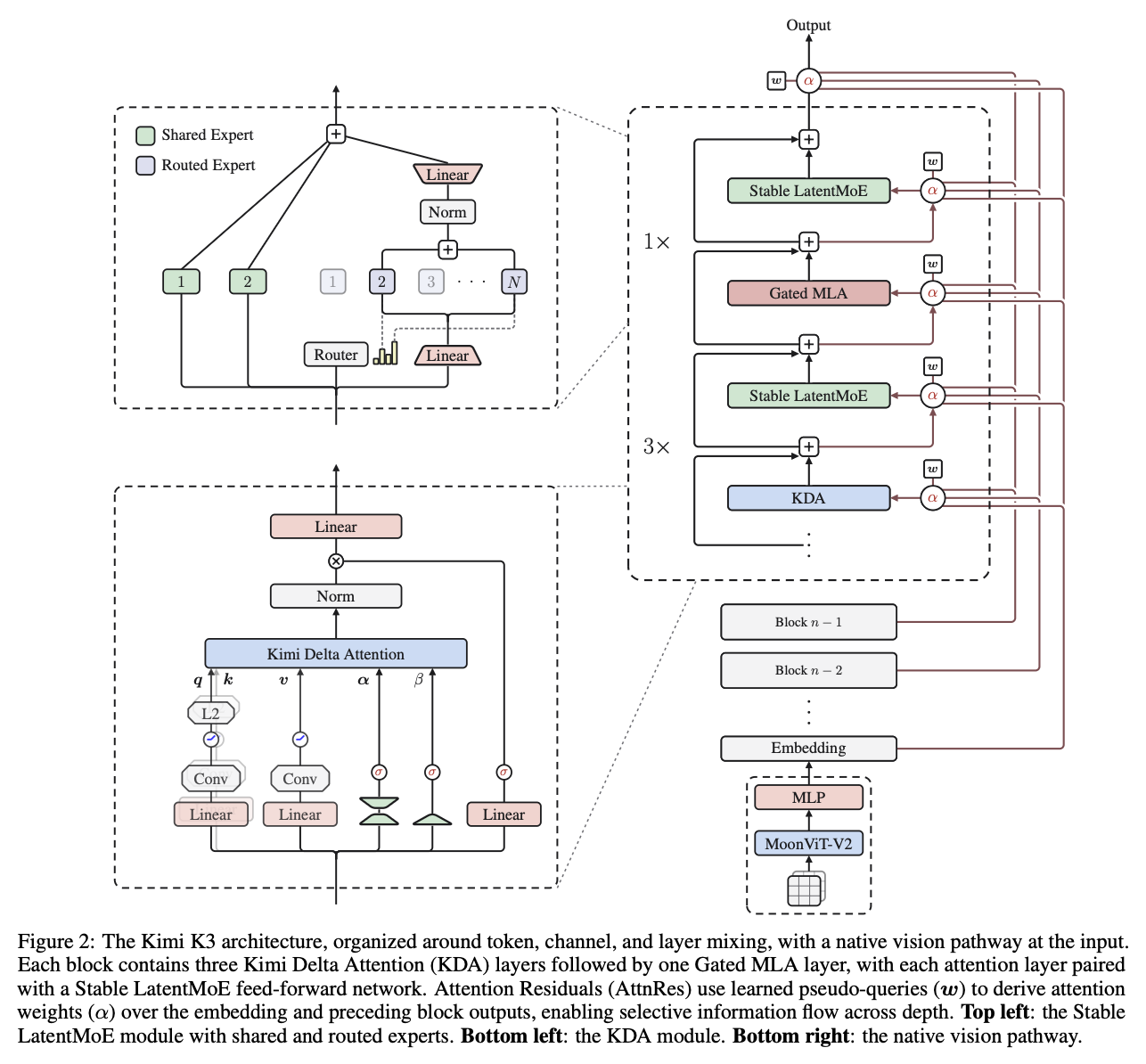
K3 is not a plain Transformer scaled until the cluster cried. The backbone mixes three ideas:
- cheaper long-sequence attention
- better depth routing
- MoE that stays balanced at extreme sparsity
Kimi Delta Attention
KDA is a linear-style attention path meant for long sequences.
Instead of growing a full key-value cache forever, it keeps a fixed-size recurrent state and updates it token by token with a forget gate.
Each block uses three KDA layers, then one Gated MLA layer. The mix is 3:1.
Softmax-style global attention still shows up. Most of the depth runs on the cheaper path.
For engineers, the practical effect is prefix-cache semantics.
KDA does not cache like classic Transformer attention. Moonshot contributed KDA plus prefill-cache support into the vLLM community for that reason.
If your serving stack assumes “KV cache as usual,” K3 will fight you.
Attention Residuals
Normal residual stacks squash earlier layers into one running state.
AttnRes does something closer to selective recall across depth. Learned pseudo-queries decide how much to pull from the embedding and from earlier block outputs.
In distributed-systems terms, this is selective replay. Not “append everything to one log and hope compression holds.”
Deep models lose detail. AttnRes is an attempt to keep useful earlier state available without paying full dense attention everywhere.
Stable LatentMoE and Quantile Balancing
K3 activates 16 of 896 routed experts per token.
At that sparsity, routing is not a side detail.
Bad balance kills throughput. Hot experts stall the cluster. Cold experts waste capacity.
Stable LatentMoE treats routing as a first-class problem. Quantile Balancing sets expert load from router-score quantiles instead of fragile hand-tuned balance losses.
Moonshot also uses SiTU-GLU activations and Per-Head Muon so training stays stable at this scale.
flowchart TD
    Token[Token] --> Router[Router scores 896 experts]
    Router --> QB[Quantile Balancing]
    QB --> Pick[Pick 16 experts]
    Pick --> Shared[2 shared experts always on]
    Pick --> Routed[16 routed experts]
    Shared --> Out[MoE output]
    Routed --> Out
Why this works: large MoEs often fail in ops before they fail in quality. If expert load skews, GPUs sit idle while one expert burns. Designing balance into training is how you keep a 16-of-896 model from becoming a paper weight.
Training That Knows About Hardware
Older open models often train dense or lightly sparse, then bolt on quantization and serving tricks later.
K3’s post-training path is more hardware-aware from the supervised-fine-tuning stage onward.
From SFT forward, Moonshot uses quantization-aware training with MXFP4 weights and MXFP8 activations.
The goal is broad accelerator support and lower memory pressure. You do not want to discover quality loss on deploy day.
Expert-parallel training uses static shapes and avoids host sync on the critical path.
That is a systems sentence with a product consequence: expert imbalance should not quietly destroy tokens-per-second once you leave the research cluster.
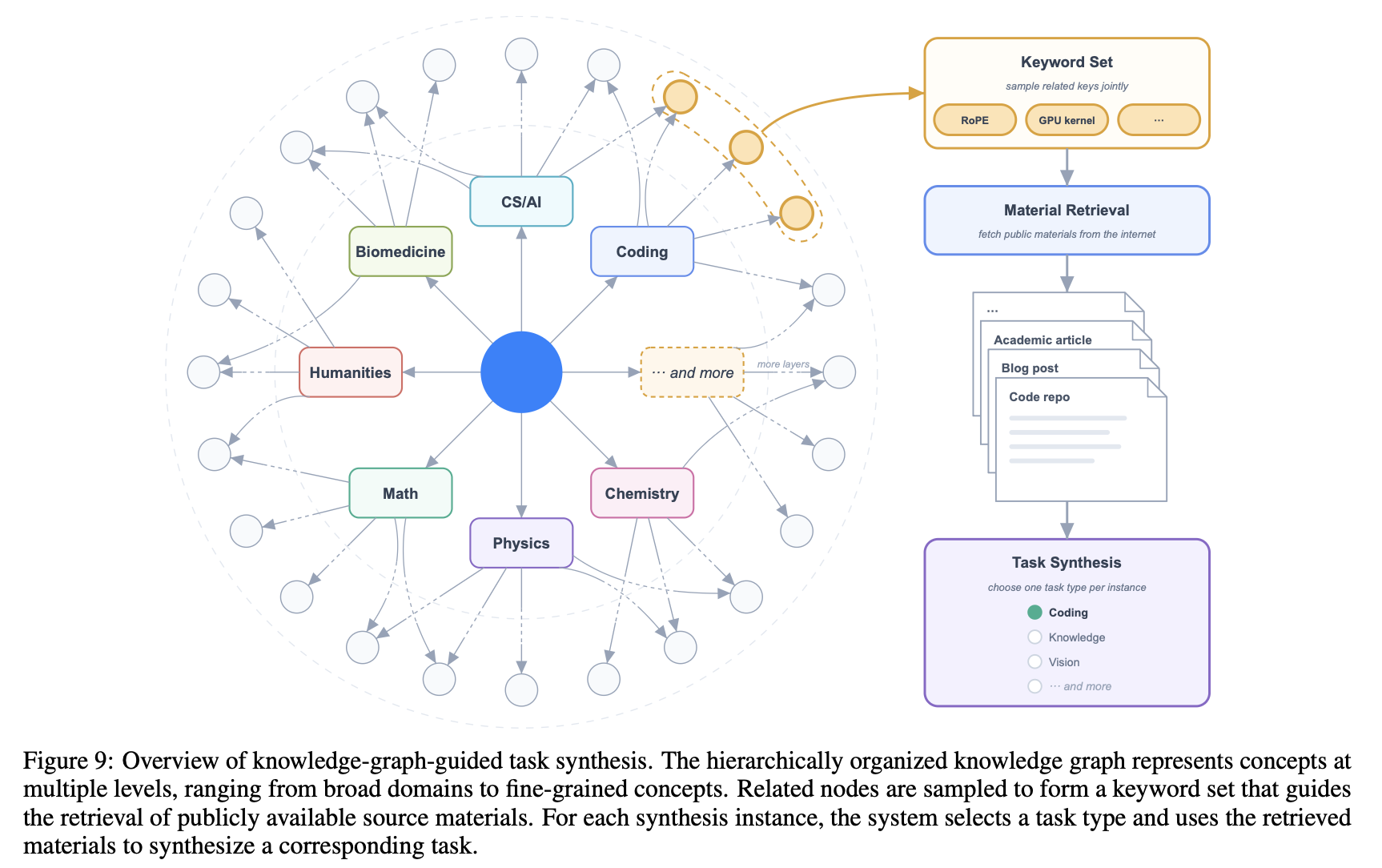
Data synthesis is also more structured than “scrape the web and hope.”
One training path uses a knowledge graph to pick related concepts, fetch public source material, and synthesize tasks by type.
Long context is not RoPE stretched as an afterthought.
K3 uses no explicit positional embedding. Position shows up through KDA’s recurrent gates and decay. That is how Moonshot claims direct extrapolation to 1M tokens.
Where the Benchmarks Point
Moonshot’s launch table is broad: DeepSWE, ProgramBench, Terminal-Bench 2.1, FrontierSWE, SWE Marathon, agent suites, office suites, vision suites.
Independent writeups and the tech-report summary put K3 near the frontier. Often second or third. Sometimes first on a specific coding track.
A few scores to keep in your head:
| Benchmark | Kimi K3 | Notes |
|---|---|---|
| DeepSWE | 67.5 | Behind Sol 73.0 and Fable 5 70.0 |
| Terminal-Bench 2.1 | 88.3 | Essentially tied with Sol 88.8 and Fable 5 88.0 |
| ProgramBench | 77.8 | Leads the reported table |
| SWE Marathon | 42.0 | Leads the reported table |
| FrontierSWE | 81.2 | Behind Fable 5 86.6, ahead of Sol 71.3 |
Read those numbers with the harness disclaimer.
Moonshot mixes Kimi Code, Claude Code, Codex, mini-SWE-agent, and vendor-reported scores. Some Fable 5 runs include fallbacks. Some Sol runs hit cyber guards.
Same-table numbers are useful for “is this real?”
They are weak for “ship everything to K3 tomorrow.”
The key insight: K3 looks strongest where work is long, tool-heavy, and messy. Short chat polish is not the claim. Multi-hour coding and agent execution is.
Capability, Cost, and Openness
For engineers choosing a default model, three axes matter more than one Elo number.
| Dimension | Kimi K3 | Claude Fable 5 | GPT-5.6 Sol |
|---|---|---|---|
| Context | 1M native | ~1M with compaction strategies | ~1M long-context stack |
| Coding posture | Near frontier; leads some long-horizon suites | Often #1 or #2 in Anthropic-friendly harnesses | Leads some same-harness coding suites |
| Agentic tools | Strong, not always best | Very strong | Strong, often fast |
| Multimodal | Native vision + video | Strong docs and charts | Strong multimodal + OpenAI tooling |
| API price / 1M tokens | 3 miss, $15 out | Roughly 50 out in public comps | Roughly 30 out in public comps |
| Weights | Open | Closed | Closed |
The price gap is not abstract.
Moonshot says the official API hits above 90% cache rate on coding workloads. If that holds in your repo loops, cache-hit input at $0.30/MTok changes the economics of long agent sessions.
Openness is the other gap.
Fable 5 and Sol stay hosted. K3 is the only model in this comparison you can put on your own supernode, inspect, and wire into a private harness.
That is the part that stayed with me after the weekend. Not “K3 is always smarter.” More: “this is the first open model I would seriously evaluate as the brain of a long-running coding agent.”
What “Long-Horizon” Looks Like in Practice
Benchmarks are abstract. Moonshot’s case studies are concrete.
They show the kind of work K3 is built for.
GPU kernels.
Models got up to 24 hours to profile, rewrite, and benchmark kernels across AttnRes, KDA, and MLA on Hopper and another vendor GPU. K3 stayed competitive with Fable 5 and beat several strong closed models.
Late in development, an early K3 already did most of the team’s own kernel work.
MiniTriton.
K3 built a Triton-like compiler from scratch: tile IR over MLIR, passes, PTX codegen. On supported roofline tests it matched or beat Triton and torch.compile on some workloads, then kept nanoGPT training stable enough to validate the full stack.
Chip for a nano-model.
In one 48-hour autonomous run with open-source EDA tools on Nangate 45nm, K3 designed and checked a chip for a nano model based on its own architecture.
Reported result: 4 mm², 100 MHz timing closure, over 8,700 tokens/s decode in simulation.
Astrophysics pipeline.
To reproduce I-Love-Q universal relations, K3 reviewed 20+ papers, coded 300+ equations of state, wrote 3,000+ lines of Python, found formula inconsistencies, and shipped an interactive dashboard.
Moonshot says that took about two hours of agent time versus one to two weeks for an experienced researcher.
These are vendor stories. Treat them as demos of range, not as a guarantee that your backlog will melt.
Still, the pattern is clear: K3 is being sold as an agent engineer, not a prettier autocomplete.
Self-Hosting Is Real, and Expensive
Open weights do not mean “runs on my laptop.”
Moonshot recommends supernode deployments with 64 or more accelerators so MoE routing and long-context attention can use large high-bandwidth domains.
A practical mental model:
Baseline interactive self-host
------------------------------
GPUs:     64x H100 / B200-class (or equivalent)
Topology: dense NVLink / NVSwitch-style fabric
Runtime:  vLLM with KDA kernels + OpenAI-compatible API
Layout:   expert-parallel shards across nodes
Watch:    expert skew, KV/prefill cache hits, inter-node bandwidth
Software is not plug-and-play either:
- You need KDA-aware attention and prefix-cache support.
- Expert checkpoints must map cleanly onto your topology.
- Your agent harness must preserve thinking history. K3 was trained that way. Drop the history, or hot-swap mid-session from another model, and quality can go unstable.
- Observability must include expert load, not only GPU util and tokens/sec.
If you do not want that ops bill, use the hosted API.
Model ID is kimi-k3. Pricing is 3.00 / $15.00 per million tokens for cache-hit input, cache-miss input, and output.
Failure Modes You Should Plan For
Moonshot is unusually direct about limits. Keep these next to the scoreboard.
- Thinking-history sensitivity. Wrong harness, missing history, or mid-session model swap can make generation unstable. Prefer a verified harness such as Kimi Code.
- Too much initiative. Long-horizon training makes K3 push ahead when intent is vague. If you need narrow behavior, put hard rules in the system prompt or
AGENTS.md. - UX gap. Competitive benchmarks do not equal best chat feel. Fable 5 and Sol still win on polish for many users.
- Harness effects. Different agent wrappers change scores. Compare same harness before you rewrite your stack.
- Self-host cost. Open weights remove vendor lock on the model. They do not remove the cluster bill.
This is where K3 connected back to my earlier writing.
I have argued that agent failures are often harness failures. K3 makes that concrete. The model expects preserved thinking state and clear boundaries. If your environment lies to it, the model will look worse than it is.
When to Choose What
Choose Kimi K3 if you:
- Need open weights at frontier-adjacent quality
- Run long coding or research agents where cache hits are high
- Care about data residency, custom harnesses, or on-prem serving
- Want native vision in the same model that writes code
Choose Claude Fable 5 if you:
- Optimize for product feel and strong Anthropic-harness coding results
- Prefer a closed API with less serving complexity
- Need top scores on suites where Fable currently leads
Choose GPT-5.6 Sol if you:
- Live in the OpenAI tool stack
- Want strong coding and agent speed with closed weights
- Prefer OpenAI’s ops and safety surface over self-hosting
Stay on a smaller open model if you:
- Cannot fund a 64-GPU-class deployment or K3 API spend
- Mostly need short chat, light coding, or offline demos
The Bottom Line
Kimi K3 does not end the closed-model era.
It changes the open-model ceiling.
The useful story is not a single win on ProgramBench or SWE Marathon. It is a set of systems choices: hybrid KDA attention for long context, Attention Residuals for depth, Stable LatentMoE with Quantile Balancing, quantization-aware training, and serving work that makes a 2.8T sparse model usable as an agent brain.
For engineers, the decision is practical.
Use the API when you want near-frontier long-horizon coding without owning MoE ops. Self-host when open weights, control, and private data beat the cluster cost. Keep Fable 5 or Sol when polish and closed-stack convenience matter more than openness.
K3 is not “the only model you need.”
It is the first open model I would seriously evaluate as the core of a long-running coding agent, with eyes open about harness design and hardware reality.
Evaluating frontier models for coding agents, or trying to decide between open weights and closed APIs? Tell me what constraint bites first: cost, latency, data residency, or harness quality. Reach out on LinkedIn.